Eastern European cinema is a diverse subject that has been scarcely regarded, especially compared to other world cinemas. From screen analysis to personal accounts, this blog is a meditation on Eastern European cultural values with emphasis on totalitarian iconography and other clandestine ciphers that have become motifs across the films of Romania, Hungary, Bulgaria, Poland, Russia, Czech Republic and East Germany.
Tuesday, October 8, 2013
Tuesday, October 1, 2013
Thursday, September 26, 2013
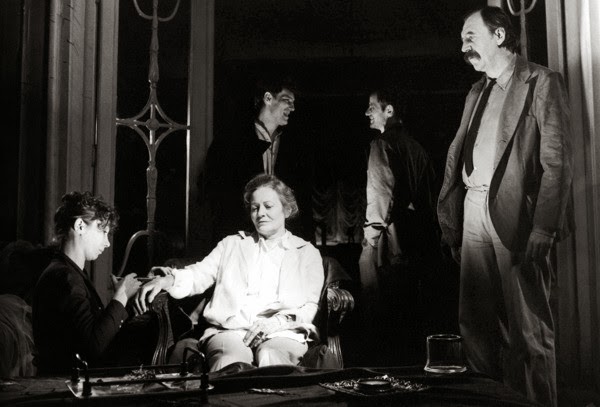
Women in Film: Hédi Temessy
By Olivia Maria Hărşan
Special Birthday Post. Today is my birthday and I've decided to do a post on a wonderful actress from Hungary, Hédi Temessy (1925-2001).
I have developed a fascination for this actress since studying the films of Béla Tarr whom she worked with on his films, Almanac of Fall (1984) and Damnation (1987). There is something so mysterious about her gaze and her piercing crystal eyes. Hédi Temessy was an ethereal beauty with a fierce talent of acting.
Special Birthday Post. Today is my birthday and I've decided to do a post on a wonderful actress from Hungary, Hédi Temessy (1925-2001).
I have developed a fascination for this actress since studying the films of Béla Tarr whom she worked with on his films, Almanac of Fall (1984) and Damnation (1987). There is something so mysterious about her gaze and her piercing crystal eyes. Hédi Temessy was an ethereal beauty with a fierce talent of acting.
In her younger years.
Still from Almanac of Fall (1984) Béla Tarr
Still from Almanac of Fall.
Still from Damnation (1987) Béla Tarr
Monday, September 23, 2013
Director's Profile: Mara Trifu
By Olivia Maria Hărşan
Mara Trifu is an emerging filmmaker in Romania whom I hope to see more work from in the next few years. Information on her background is scarce, in fact, all I managed to stumble across is that she is a visual artist from Transilvania who lives and works in Bucharest.
I recently saw her documentary short Japanese Fig Tree/ Gutuiul Japonez (2011) which competed at the annual Gopo Awards in 2012, but unfortunately did not gain the attention it deserves. This is a stunning picture from composition, editing, sound and right down to the narrative itself. It focuses on a 90 year old woman, Madame Grosu, who lives alone and shows us the daily tasks she is faced with, for example, the effort of reaching up high to water her plants and providing for a bunch of abandoned kittens that "some Turkish fella" left her with . She admires her backyard and the beautiful plants that dwell there, in particular a Japanese Fig Tree. There is also a personal story that she reveals to us. She talks of the regret she is faced with everyday because of final words that were spoken and/or unspoken towards a late loved one. Trifu presents a sad, but heartfelt and beautiful picture of life where the focus on sunlight and chiaroscuro-like shadow become a metaphor for time, life and death.
Trifu has directed another short titled You Can't Hide Love From the Gypsies (2011), but I am waiting desperately for more. It's absolutely exciting to see women filmmakers emerging in Eastern Europe.
View a snippet of the film here.
Mara Trifu is an emerging filmmaker in Romania whom I hope to see more work from in the next few years. Information on her background is scarce, in fact, all I managed to stumble across is that she is a visual artist from Transilvania who lives and works in Bucharest.
I recently saw her documentary short Japanese Fig Tree/ Gutuiul Japonez (2011) which competed at the annual Gopo Awards in 2012, but unfortunately did not gain the attention it deserves. This is a stunning picture from composition, editing, sound and right down to the narrative itself. It focuses on a 90 year old woman, Madame Grosu, who lives alone and shows us the daily tasks she is faced with, for example, the effort of reaching up high to water her plants and providing for a bunch of abandoned kittens that "some Turkish fella" left her with . She admires her backyard and the beautiful plants that dwell there, in particular a Japanese Fig Tree. There is also a personal story that she reveals to us. She talks of the regret she is faced with everyday because of final words that were spoken and/or unspoken towards a late loved one. Trifu presents a sad, but heartfelt and beautiful picture of life where the focus on sunlight and chiaroscuro-like shadow become a metaphor for time, life and death.
Trifu has directed another short titled You Can't Hide Love From the Gypsies (2011), but I am waiting desperately for more. It's absolutely exciting to see women filmmakers emerging in Eastern Europe.
View a snippet of the film here.
Stills from the film.
Mara Trifu with her actress.
Tuesday, September 17, 2013
Film Review: Outbound/Periferic (2010) Bogdan George Apetri
By Olivia Maria Hărşan
I finally sat down and watched the Romanian film Periferic. At the time of its release, I'd heard only good things about it, particularly Ana Ularu's exceptional role as Matilda, a rough-edged mother with a broken heart. The film begins with her release from prison, where it is understood she was serving time for a crime she did not commit. Matilda is on parole but her plan is to find her long lost son, Toma (Timotei Duma) and flee the country. She locates an ex-lover, Paul (Mimi Branescu), who is also Toma's biological father, but finds that he has placed him in an orphanage. Money matters between Matilda and Paul end in a violent way - Paul is some kind of mafioso middle man. Matilda manages to scramble away with Paul's money, or rather what he owed her for doing time. Needless to say, she finds her son but the ending is a sad one.
What stood out for me the most in this film is the emphasis on heat. You know how some people discuss the concentration of summertime heat in New York as if its some kind of phenomenon?... Think Spike Lee's Crooklyn (1994)... Well the same goes for Bucharest - 45 degrees of asphalted metropolis. It seemed as though the heat was concocting a maddening vibe that conjoined all the characters into some kind of abysmal warp. There was no ending to this story, only a perpetual circle of tragic events.
There were also some impressive cinematographic moments. The sun shining directly into the camera as we are introduced to Matilda's brother Andrei (Andi Vasluianu) and the tracking shot of Andrei's taxi, filmed from behind the vehicle as it swerves into a petrol station, thus indicating a sense of awkwardness that is about to unfold between Matilda and her sister-in-law, Lavinia (Ioana Flora). But there is also the eerie shot of Toma's shadow as a passenger looking outwards onto the surrounding fields. It captures a sense of ghostliness that begs the question, was he even real?
I finally sat down and watched the Romanian film Periferic. At the time of its release, I'd heard only good things about it, particularly Ana Ularu's exceptional role as Matilda, a rough-edged mother with a broken heart. The film begins with her release from prison, where it is understood she was serving time for a crime she did not commit. Matilda is on parole but her plan is to find her long lost son, Toma (Timotei Duma) and flee the country. She locates an ex-lover, Paul (Mimi Branescu), who is also Toma's biological father, but finds that he has placed him in an orphanage. Money matters between Matilda and Paul end in a violent way - Paul is some kind of mafioso middle man. Matilda manages to scramble away with Paul's money, or rather what he owed her for doing time. Needless to say, she finds her son but the ending is a sad one.
What stood out for me the most in this film is the emphasis on heat. You know how some people discuss the concentration of summertime heat in New York as if its some kind of phenomenon?... Think Spike Lee's Crooklyn (1994)... Well the same goes for Bucharest - 45 degrees of asphalted metropolis. It seemed as though the heat was concocting a maddening vibe that conjoined all the characters into some kind of abysmal warp. There was no ending to this story, only a perpetual circle of tragic events.
There were also some impressive cinematographic moments. The sun shining directly into the camera as we are introduced to Matilda's brother Andrei (Andi Vasluianu) and the tracking shot of Andrei's taxi, filmed from behind the vehicle as it swerves into a petrol station, thus indicating a sense of awkwardness that is about to unfold between Matilda and her sister-in-law, Lavinia (Ioana Flora). But there is also the eerie shot of Toma's shadow as a passenger looking outwards onto the surrounding fields. It captures a sense of ghostliness that begs the question, was he even real?
Subscribe to:
Posts (Atom)


.avi_006517320.jpg)