By Olivia Maria Hărşan
Noted and perhaps fetishized for her husky voice and sleek brown hair, cult film actress Sonja Savić, became something of a rebel in Serbia (former Yugoslavia), voicing strong opinions against her nation's political changes. Born in Čačak, Yugoslavia in 1961, Savić impressed audiences with a series of strong performances throughout the 1980s before turning her focus to addressing cultural matters of her country. She died in 2008, reportedly from a drug overdose.
By Olivia Maria Hărşan
For those who have seen Miloš Forman's The Firemen's Ball/ Hoří, má panenko (1967) might think it to be a strange choice for the 'fashion in film' section of this blog, but I beg to differ. No matter how low budget the film, the amount of socio-political restrictions of its context or even the absence of a costume designer per se, there is always room for fashion analysis. In this case, the party scene stands out as a peculiar emphasis on costuming through its focus of female sexuality.
The narrative is centered around a catered party hosted by the local fire department. The aim of the event is to celebrate the birthday of the honorary chairman and to judge a poorly organised beauty queen contest. Throughout the evening a series of farcical events occur, which lead to complete havoc in the community hall. The chosen finalists, all teenage girls, refuse to go on stage, instead seeking refuge in the ladies bathroom. Men start chasing women around while older folk laugh at the scene from the sidelines.
The cinematography is unconventional and bold. For the majority of the film, the camera invades the personal space of the characters with close-ups comparable to John Cassavetes' Faces (1968). What is most impressive, though, are the swift visual angles throughout the chaotic party scene. A great deal of attention is paid to the female body particularly via the fetishized images of long necklaces leading to the breasts, evening styled coiffures, cat's eye make-up, sheer thigh high stockings and patent black heels.
The film was banned in Czechoslovakia for supposedly obtaining dissident values contrary to the Communist idealism of the time. In response, Forman states :
"I didn't want to give any special message or allegory. I wanted just to make a comedy knowing that if I'll be real, if I'll be true, the film will automatically reveal an allegorical sense. That's a problem of all governments, of all committees, including firemen's committees. That they try and they pretend and they announce that they are preparing a happy, gay, amusing evening or life for the people. And everybody has the best intentions... But suddenly things turn out in such a catastrophic way that, for me, this is a vision of what's going on today in the world." (Hames P 2005, The Czechoslovak New Wave, Wallflower Press, London and New York, pp. 120).
By Olivia Maria Hărşan
A captivating image of the Russian director, screenwriter, cinematographer and producer Marina Goldovskaya on set - a woman with a camera in a Socialist context.
By Olivia Maria Hărşan
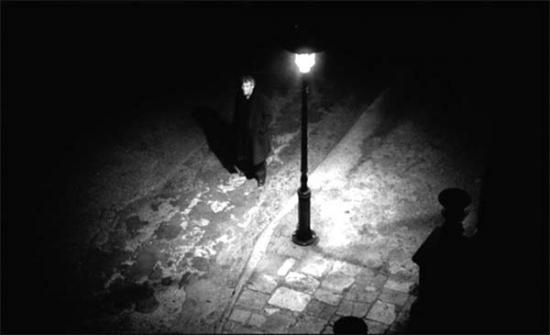
Béla Tarr's 'The Man From London' (2007)